“The Neon Demon” Reveals The True Face of the Occult Elite
Post January 10, 2017
by Edward Morgan
The Neon Demon is a movie about the fashion industry and its obsession with youth and beauty. However, through its story and symbolism, the movie reveals the disturbing mindset of the fashion world and the occult elite behind it.
Warning: This article addresses disturbing subject manners.
Also: Gigantic spoilers ahead!
The Neon Demon is painful to watch. Not only is it filled with long hypnotic sequences that emphasize the shallow self-importance of the fashion world, it deliberately dwells on some of the most upsetting human practices possible including pedophilia, necrophilia, cannibalism and ritual killings. All of these horrors are presented in an aesthetically pleasing matter and placed in a cool, fashionable context in an apparent attempt to normalize them.
Like most of the entertainment analyzed on the Vigilant Citizen, this movie leaves a foul feeling, as if one’s very soul was violated by what was just witnessed. Of course, this kind of result from a “psychological horror movie” is to be expected, but the most disturbing part of this movie isn’t the fiction: It is the dark “real world” truths it appears to celebrate. Indeed, when one knows about the dark side of the entertainment industry – and the occult elite that owns it – the movie becomes a disturbing manifesto, an indulgent celebration from people who revel in darkness. In short, it discloses what the industry is truly about, how it truly functions, and who is truly behind it.
Through the story of a innocent young girl who moves to L.A. with big dreams of being an international supermodel, The Neon Demon reveals the true ugly face of the entertainment industry.
Let’s look at The Neon Demon.
Culture of Death
Subjecting oneself to this kind of movie means being exposed to the twisted mindset of those behind it. And right from the start, The Neon Demon gives us all eyeful of what the fashion world is about: Celebrating a culture of death while preying on youth and innocence.
 In the first scene of the movie, Jesse poses in a photoshoot where she appears dead after having her throat slit.
If you’ve read past editions of Symbolic Pics of the Month, you’re already aware of this trend happening in actual fashion shoots. Here is one example of a real photoshoot where the model is basically a “fashionable corpse”.
 “Pin Up”, W Magazine, 2008
Preying on Youth
The model in the bloody photoshoot is Jesse, a 16 year-old model who is “new in town”. She meets Ruby, a make-up artist who nonchalantly asks her very specific questions.
 As Jesse reveals that she’s a young and vulnerable aspiring model, Ruby gives her intense looks as if saying: “I want to consume you” … literally.
– You’ve just got to L.A., Jesse?
– How did you know?
– You’ve got that look. Don’t worry honey. That whole deer-in-the-headlights thing is exactly what they want.
The “deer-in-the-headlights” thing means youth and innocence. “They” prey and feed on it … literally.
After learning about Jesse’s vulnerable situation, Ruby invites her to a party. This is how newcomers get introduced to the claustrophobic social bubble that is the fashion world.
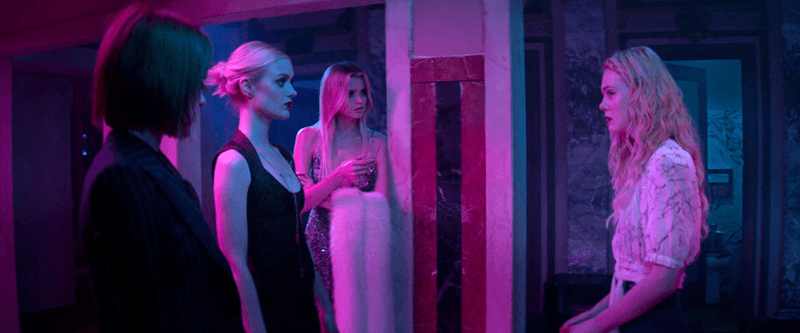
 At the show, Jesse is introduced to two other models, Gigi and Sarah, who also quickly interrogate Jesse.
Ruby mentions that lipstick colors tend to sell more when they’re named after food or sex. She then asks Jesse:
– Are you food or are you sex?
This odd question will become extremely relevant later in the movie. Indeed, there are two ways her vital energy can be “consumed”.
The girls then watch a bizarre show that features a tied-up model. At the climax of the show, she is lifted in the air and placed in position that carries important symbolic meaning.
 While music is blaring and lights are flashing, the bound model floats in the air.
The model’s position is strongly reminiscent to Louise Bourgeois’ Arch of Hysteria.

Louise Bourgeois’ “The Arch of Hysteria”
This particular piece of art and position was shown to be important to the occult elite. Serial killer Jeffrey Dahmer placed one of his headless victims in that specific position (you can view the disturbing picture here if you absolutely need to).
Dahmer was a cannibal. The Neon Demon also deals with cannibalism. And more. Like abusing minors.
 Keano Reeves plays the role of a motel owner who rents rooms to aspiring models. He’s a creep.
At one point, the motel owner tells Jesse’s friend to check out a girl at his motel.
“Take a peek in room 214 if you get a chance. Runaway. Thirteen years old. Real lolita sh*t. Room 214. Gotta be seen.”
 Later in the movie, the motel owner creeps into Jesse’s room to insert a knife down her throat. It is a disturbing reference to violent abuse of young models.
Through these various scenes, we understand that Jesse has entered a messed up world that is looking to consume her.
Entering the Industry
Jesse is soon recruited by a fashion agency that promises her to work with “all of the big designers”, which will lead her to”international success”. When Jesse admits that she’s only 16 years old and that she did not graduate from high school, she is told to tell people that she’s 19.
Nobody cares that she is a minor. In fact, her youth gives her that “something” that the industry desperately preys on. Youth is not only used to sell copies of magazines, it is exploited on a deeper level. Primitive civilizations used to sacrifice young virgins to the gods because they were believed to have the most “magical potency”. This concept is still alive today. People with great wealth, power, and influence believe in these occult concepts that most think to be outdated. The Neon Demon addresses these things in a thinly veiled matter.
When Jesse goes to her first photoshoot with a “big” photographer, things get weird.
 At the photoshoot, Jesse has a shiny thing glued to her face. Its shape is reminiscent to the head of Baphomet, complete with horns and the torch of illumination. While this might be a coincidence, the occult context of the movie would say otherwise.
When the photographer sees Jesse with her golden stickers, he appears taken with her. He tells everybody present to leave the room. He then orders Jesse to take off all of her clothes. She’s still 16.
 Then, in a strange scene, the photographer passionately rubs Jesse with gold stuff, strangely focusing on her throat in scene that might simultaneously refer them doing it and her being “the golden girl” of the industry.
Transformation
Jesse’s “It” factor leads her to star at a fashion show. This show begins normally but soon turns into a long, hypnotic, occult ritual that appears to profoundly transform Jesse.
As Jesse walks down the runway, an alternate scene simultaneously takes place in a “higher” dimension. The fashion show is Jesse’s initiation to the industry, where she discovers her new alter persona.
 Jesse finds herself under an illuminated pyramid – symbol of the occult elite.
 We see the birth of a new Jesse who cannot stop kissing herself.
After the show, a new, sexy, non-innocent Jesse is born.
 A new Jesse is “unveiled”. She is not a goodie-two-shoes anymore. She wants to be part of the glamorous and supercifial world of fashion.
Under the Eye All-Seeing Eye
As Jesse progresses into the fashion world, we are subtly introduced to the dark occult world that rules it. We are also heavily introduced to the symbol that represents it: the ubiquitous All-Seeing Eye (of course). In the movie, the all-seeing eye, aka the eye in the sky, is associated with the moon.
 Under a full moon, Jesse talks about how she has no discernible talent except for being pretty … and about how she used to talk to the moon.
“When I was a kid, I would sneak out the roof at night. I thought the moon looked like a big round eye. And I would look up and say: Do you see me?”
Jesse wanted to be noticed by the entertainment industry. She wanted the “big round eye” to see her. Well, it saw her. She got initiated into the industry.
When things get dangerous at her motel, Jesse is invited to stay at Ruby’s house … and things get even weirder. The deer-in-the-headlights is now trapped inside an elite home, and the predators are circling in.
 At first, Ruby forces herself on Jesse, who admits being a virgin.
When Jesse pushes her away, Ruby becomes mad. If Jesse cannot be sex, she will be food (you remember the quote above?). But first, Ruby has to do something real quick.
In the next scene, we see Ruby at her second job in a mortuary home where she does makeup on corpses. When she receives the body of a young woman, Ruby becomes very excited.
 Ruby kisses and fondles a dead body. Yes. The movie goes there. For a long time.
While this disturbing scene is happening, another scene is juxtaposed to it.
 While Ruby is indulging into all-out necrophilia, Jesse sensually touches herself.
This annoying bit is dragged on for a long time. As Ruby gets excited and moaning sounds intensify, we realize that the movie makers are actually trying hard to make this scene arousing to the viewers. It’s like, they’re really into that stuff and they want us to be into it as well.
After this unnecessary scene, Jesse dresses up for no apparent reason. She becomes the sacrificial lamb.
 Jesse puts on a white dress, looking as if she was a young girl about to be sacrificed to the gods.
When Jesse goes outside, Ruby and her two model friends go after her and kill her.
 Blood sacrifice. The movie makers made this death scene as fashionable as possible.
Ruby and her friends do not simply kill Jesse … they consume her. Literally.
 Ruby is literally bathing in Jesse’s blood. The two other models are also drenched in blood in the shower.
After this nauseating scene, we see Ruby partaking in a strange ritual under a full moon – the “big round eye”. She is demonstrating servitude to the the All-Seeing Eye.
 Ruby lays on the floor, basking in moonlight.
 As if to emphasize the culture of death, Ruby is then seen laying where Jesse has been buried.
Meanwhile, the two other models who consumed Jesse are featured in a high-profile photoshoot. Apparently, eating Jesse imparted them the “It” factor that makes them desirable by the industry again. However, during the photoshoot, one of the models feels sick.
 The model cannot take having Jesse inside of her. She stabs herself in the stomach and throws up Jesse’s … eyeball.
 The other model picks up the undigested eyeball.
What does she do with the eyeball? Guess.
 She eats it! She eats the whole thing!
Then, with a completely vacant look on her face, the model goes back to the fashion shoot. ** Cue pop song by trendy pop singer Sia. **
So, what the hell just happened? What is the moral of the story?
Well, “moral” is not really a word that applies here. “Moral” means “concerned with the principles of right and wrong behavior and the goodness or badness of human character”. There is no “moral” here, just an exposition of what the fashion world is about.
The Neon Demon describes how the industry preys on young girls (preferably very young), trapping them in a world they cannot escape. It depicts how people deep in the industry are involved in sick practices motivated by dark rituals.
Jesse, a simple girl from a small town, was full of the natural beauty and vitality that the soulless Hollywood vampires so desperately crave. After years inside the cesspool that is the fashion industry, all the humanity has been sucked out from them, leaving them yearning for young blood.
Innocent souls not yet tainted by the industry are lured towards the “inner circle” to then be exploited. When they cannot be used anymore, they are disposed of. Those who actually make it in the industry are those who profit from the exploitation – those who “absorb” the life force of others. Those who make it are those who have completely sold their soul and are willing to swallow the occult elite’s eyeball to keep going.
The Neon Demon is about celebrating all of this. Literally.
 The premier of Neon Demon featured the stars eating eyeballs. Behind them is a pyramid with a missing eyeball at the top.
In Conclusion
After watching The Neon Demon, it is not surprising to learn that it failed at the box office. It is an indulgent, self-aggrandizing, promotional piece by the industry and for the industry.
And no, the movie does not aim to “expose” or “reveal” anything. It actually attempts to make everything cool, trendy and fashionable. What makes this movie more disturbing is the fact that there is actual truth behind the fiction. People at the highest levels of these industries are indeed steeped in systematic abuse, exploitation, and all kinds of other sickening practices. They are so protected by the system that they can make movies about this crap and nobody interrupts their fun.
Why are they so into this? Well, once you swallow the occult elite’s eyeball, you’re either infected for life … or you die. ** Cue pop song by trendy singer Sia **.
Discernment is recommended.
All articles are of the respective authors and/or publishers responsibility.
No religious or political belief is defended here.